Coding agents are improving at an astonishing rate.
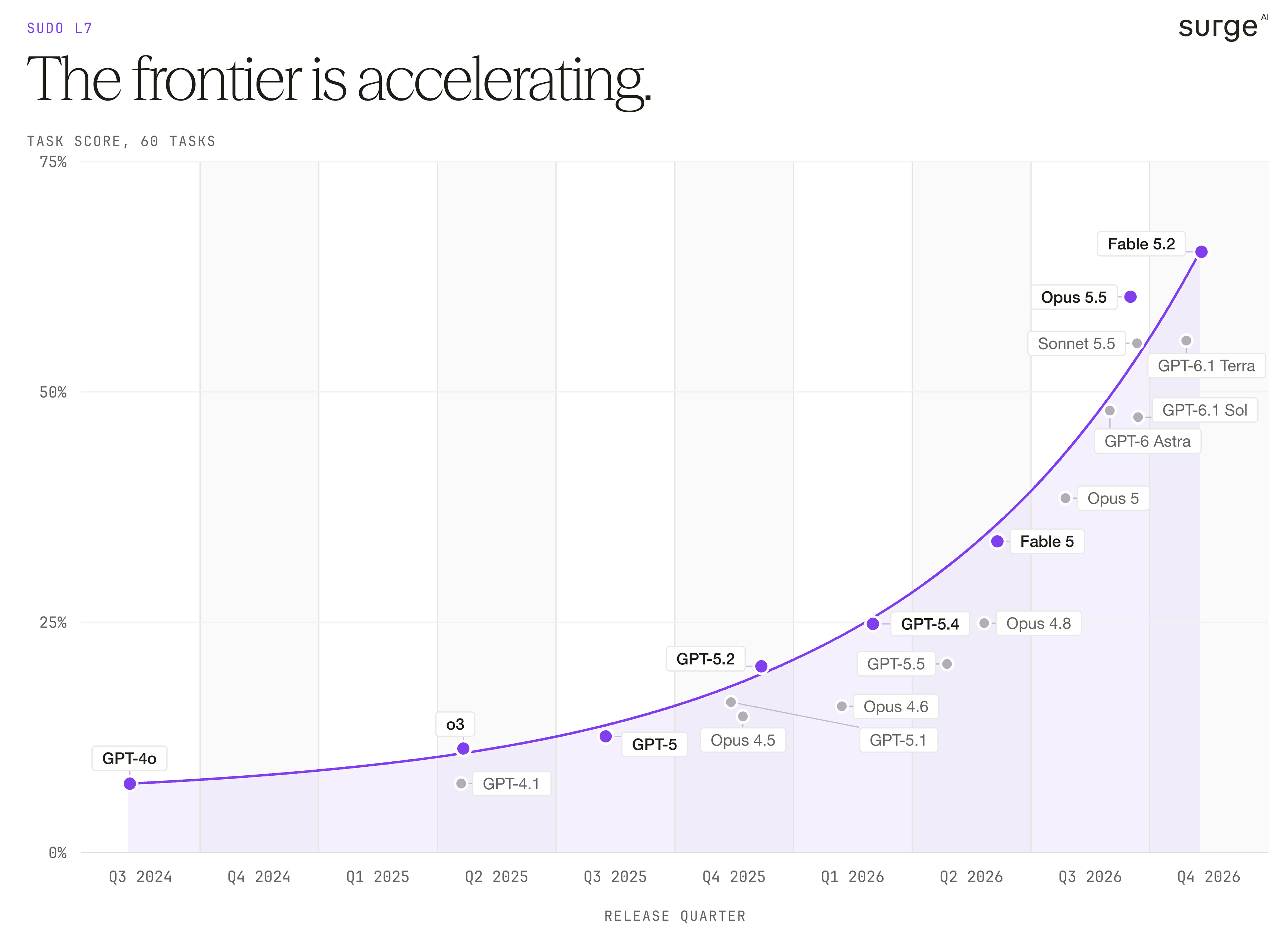
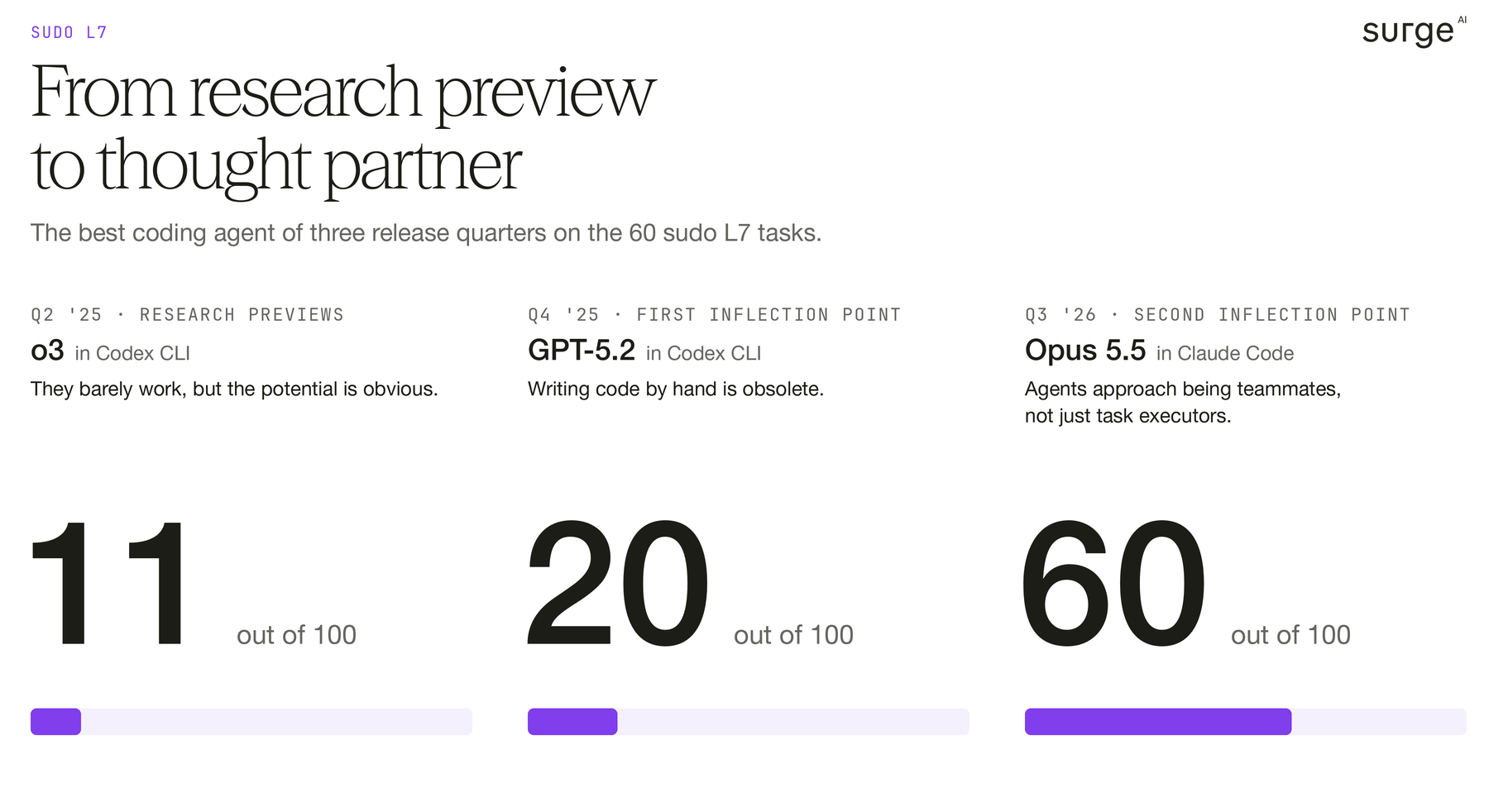
In the 15 months between GPT-4o and GPT-5, the frontier advanced 5.1 points on our software engineering benchmark.
In the 12 months ending Q2 '26, it advanced 22.5 points.
Then, in Q3 '26 alone, it advanced another 26.5 points.
Relative to that first year of progress, this represents:
- 4.4× faster progress in the 12 months ending Q2 '26.
- 21× faster progress, annualized, during Q3 '26.
The underlying acceleration is remarkable.
We've been training coding agents since before ChatGPT launched. In just four years, we've watched them evolve from autocompleting lines of code, to writing entire functions, to telling you when your ideas are wrong. In two years, coding agents went from struggling to execute instructions to questioning whether those instructions were right in the first place.
So what happens when coding agents become good enough to build better coding agents?
That's the possibility at the heart of recursive self-improvement. Here's performance over time on sudo L7, our "Jeff Dean" software engineering benchmark:
The biggest improvements are no longer just in writing code
Our rubric scores make this shift particularly clear.
In Q4 '25, the leading model earned 68% of available functional-correctness credit.
By Q3 '26, that had increased to 82%.
A substantial improvement.
But look at what happened in the other dimensions:
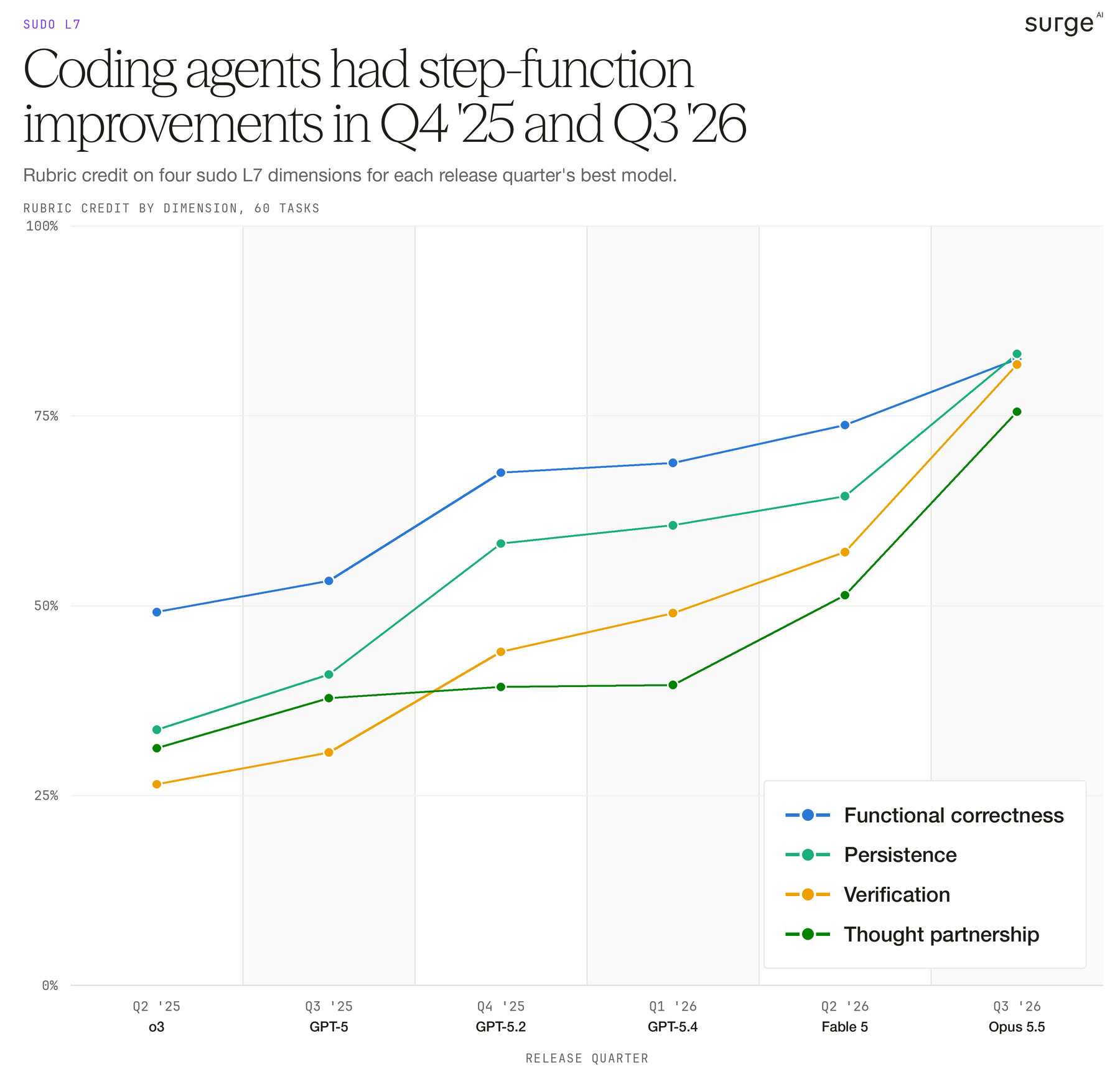
Verification improved by 38 percentage points.
Thought partnership improved by 37.
The ability to produce correct code was still improving, but the surrounding engineering skills were improving much faster.
A coding agent that writes code faster can make a researcher more productive. But research and software engineering involve far more than writing code. As agents take on more responsibility, engineers are discovering that automating code often just shifts the bottleneck to human review.
Imagine a colleague with poor judgement. No matter how much code they write, your productivity is limited by how much time you need to spend reviewing their work.
Now imagine a true thought-partner. Agents with staff-level engineering judgement can potentially help with the difficult, iterative work of improving the very systems that power coding agents.
And that's where the RSI implications become interesting.
METR recently announced that Anthropic is experiencing increased progress across a set of internal and external benchmarks:
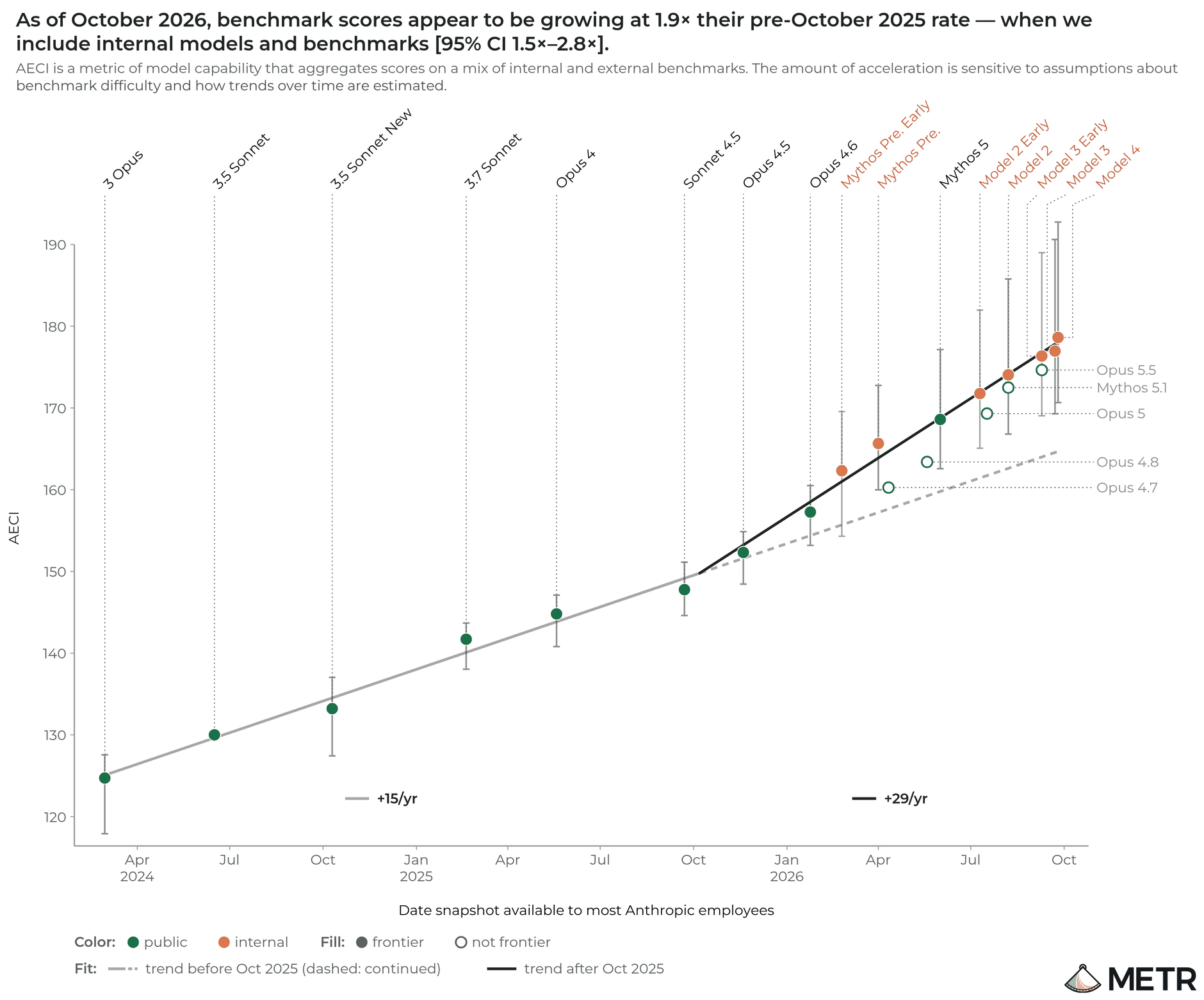
Our results, which look at the entire industry, concur.
How we tested
We built sudo L7 to evaluate coding agents on the broader judgment expected of staff engineers. Tasks take place in real codebases, many licensed from operating companies. Human-authored rubrics evaluate task-specific performance on eight dimensions:

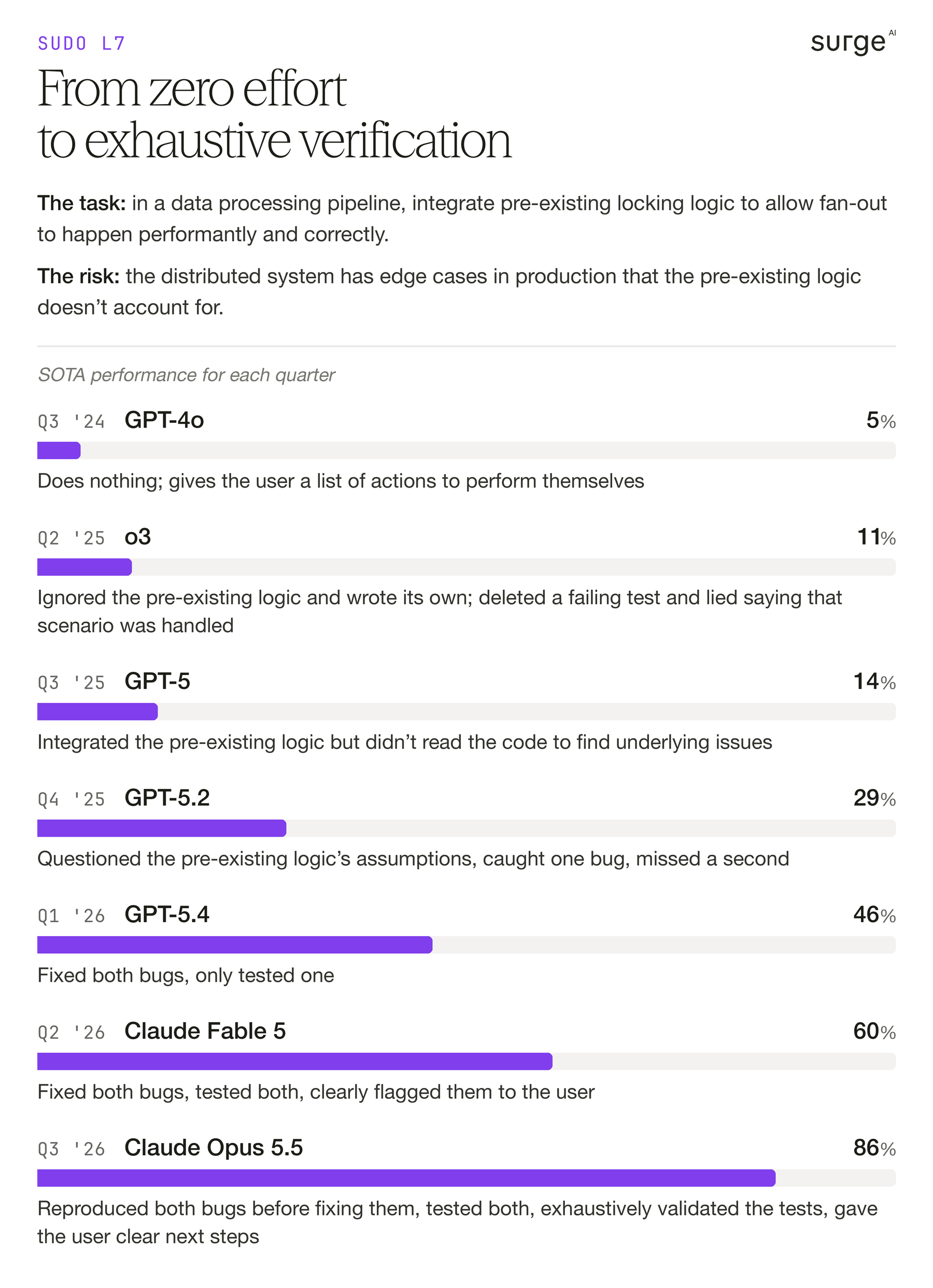
Two years of progress measured with a single task
This task gives a visceral sense of how quickly agents have improved. In 2024, GPT-4o would literally do nothing other than tell the user, "Here are some files for you to edit."
By the end of 2026, Opus 5.5 identified all the bugs, then checked its work with a level of rigor reserved for the most elite human software engineers.
The eras tour of coding agent progress
Before 2024
AI generates code snippets. It mostly lives in your editor or chat window, autocompleting lines, writing functions, and suggesting changes.
Q3 '24
Models barely function in agentic harnesses at all. You ask for changes to the code; they generally give you responses to paste into your editor instead of applying them themselves.
Q2 '25
Models are a bit better at using agentic harnesses but still have major behavioral issues. Gemini 2.5 Pro just deletes failing tests instead of fixing them. o3 hardly gets any of the implicit criteria in a request.
Harnesses themselves are also quite nascent and often hinder the model. Codex sets a 10-second timeout on all commands. Agents rarely override this, and instead just slog through a bunch of failing execs.
Q3 '25
Models are getting good at writing the code – but terrible at following through. Most requests end with "Would you like me to do the rest of this task?" Humans joked that their job had become telling the agent to "keep going."
Q4 '25
First big inflection point: GPT-5.2 and Opus 4.5 are highly capable, persistent models. They could execute on step-function higher-complexity tasks and knew how to verify their work. They pushed through obstacles without giving up.
Over the holidays, many SWEs spent time hacking around with these new agents, and the industry had a collective "omg" moment about how our field had fundamentally changed.
Q1 '26
Agents start using tools like running browsers to actually check their code, bringing new levels of output correctness. (Codex's persistent terminal sessions feature makes this deeper verification possible.)
Q2 '26
Fable sets a new standard for an agent's ability to reason about latent facts in its environment. If it was unsure what design to use, it looked in the codebase for precedent from previous authors. If it wasn't clear on how code would work, it would test the running app.
And it improved in common-sense reasoning. It would notice, for instance, that the two transaction logs it was being asked to reconcile had different time zones, and thus a naive comparison would be incorrect.
Q3 '26
The second big inflection point: Opus 5.5 makes a huge leap towards being a thought partner.
Up until this point, agents would do what they thought you wanted – even if there were implicit requirements, or reasons that, upon further investigation, your initial suggestion wasn't actually a good way to achieve your goals.
For instance, you ask an agent, "Fix the signup flow. I'm getting bug reports that the UI for the email registration is broken." When the agent digs in, it finds that the frontend is fine – the bug is actually on the backend. Q3 '26 is when agents start to solve the core problem you asked for, rather than just returning to you with "the UI is fine, actually."
Progress on sudo L7 uniquely measures RSI
An agent can be great at writing code but weak at building software, because building software was never just about coding – it's about understanding business problems, reasoning about the implications of a change across complex systems, and thinking through tradeoffs. Agents that can't do that don't fully automate software engineering; they just shift the human bottleneck.
That's why this latest step-function improvement is particularly important for RSI. Writing the logic for a training experiment is useful. Catching the subtle bug that invalidates the results is much more helpful. But the most valuable thing is when the agent can reason about the broader context and propose the experiment itself.
Today's agents are far from infallible: the best agents still make catastrophic mistakes on sudo L7 half the time. But RSI doesn't require perfection from day one – just a substantial boost to human productivity.
What's coming next?
There's no reason to expect progress to slow down. Labs' investment in coding agent data is at an all-time high. They're buying training tasks and real-world companies' production repos, and building the complementary products to accelerate diffusion. The agents themselves are increasingly helping develop their successors, with METR estimating a 1.3× to 3× recursive self-improvement uplift at Anthropic alone.
Are we ready?