Coding agents are improving at a staggering rate. And they’re accelerating.
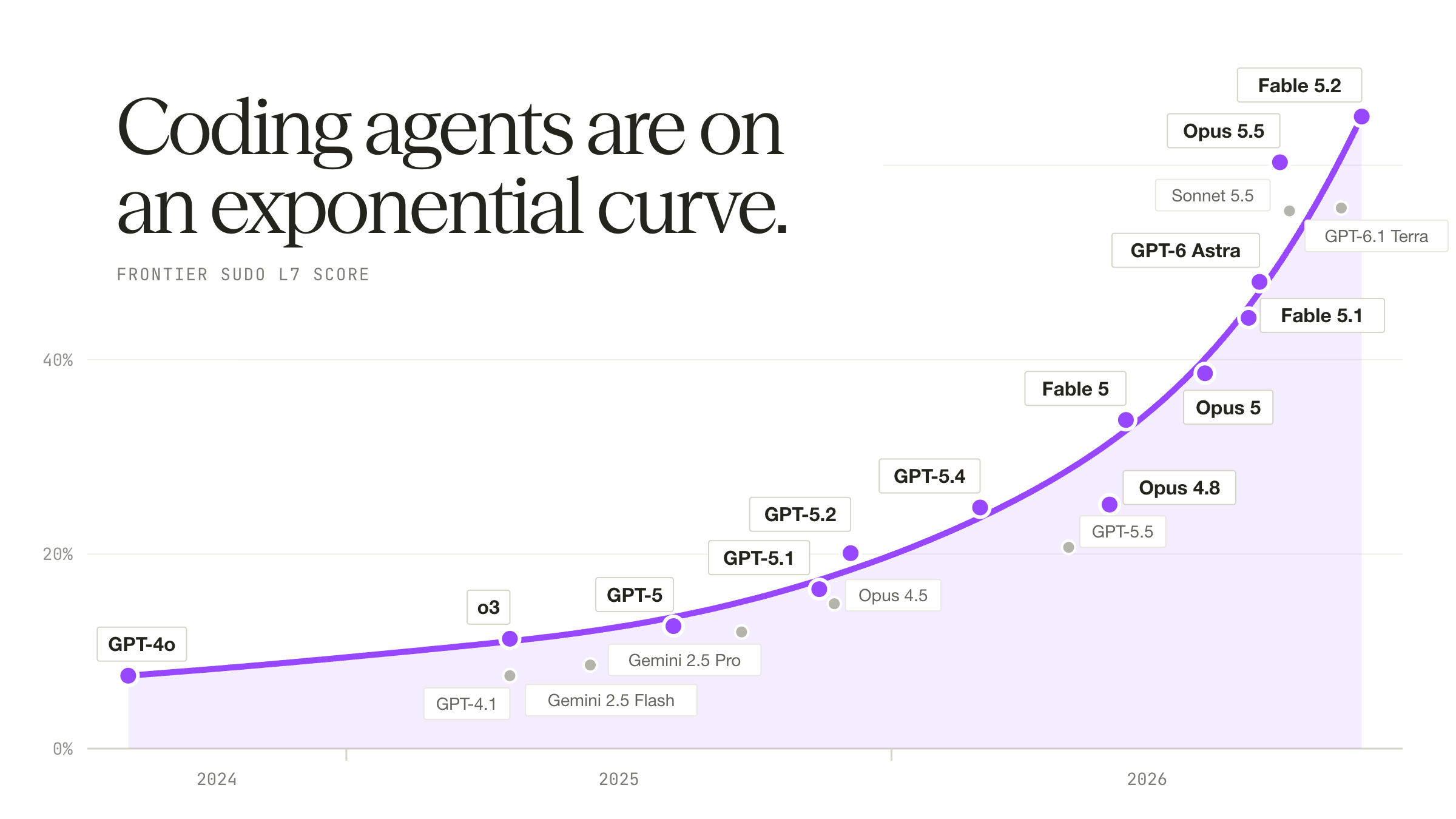
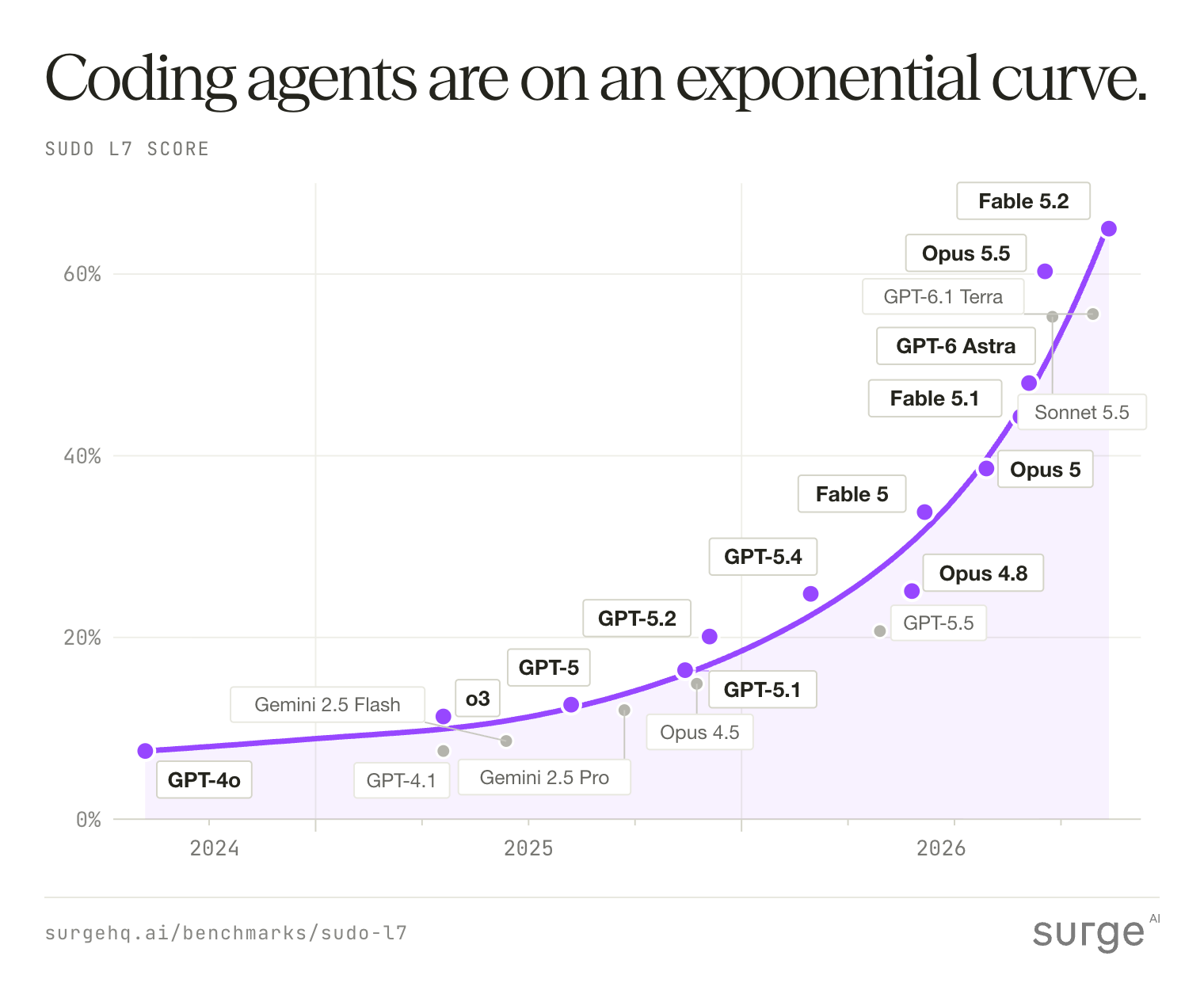
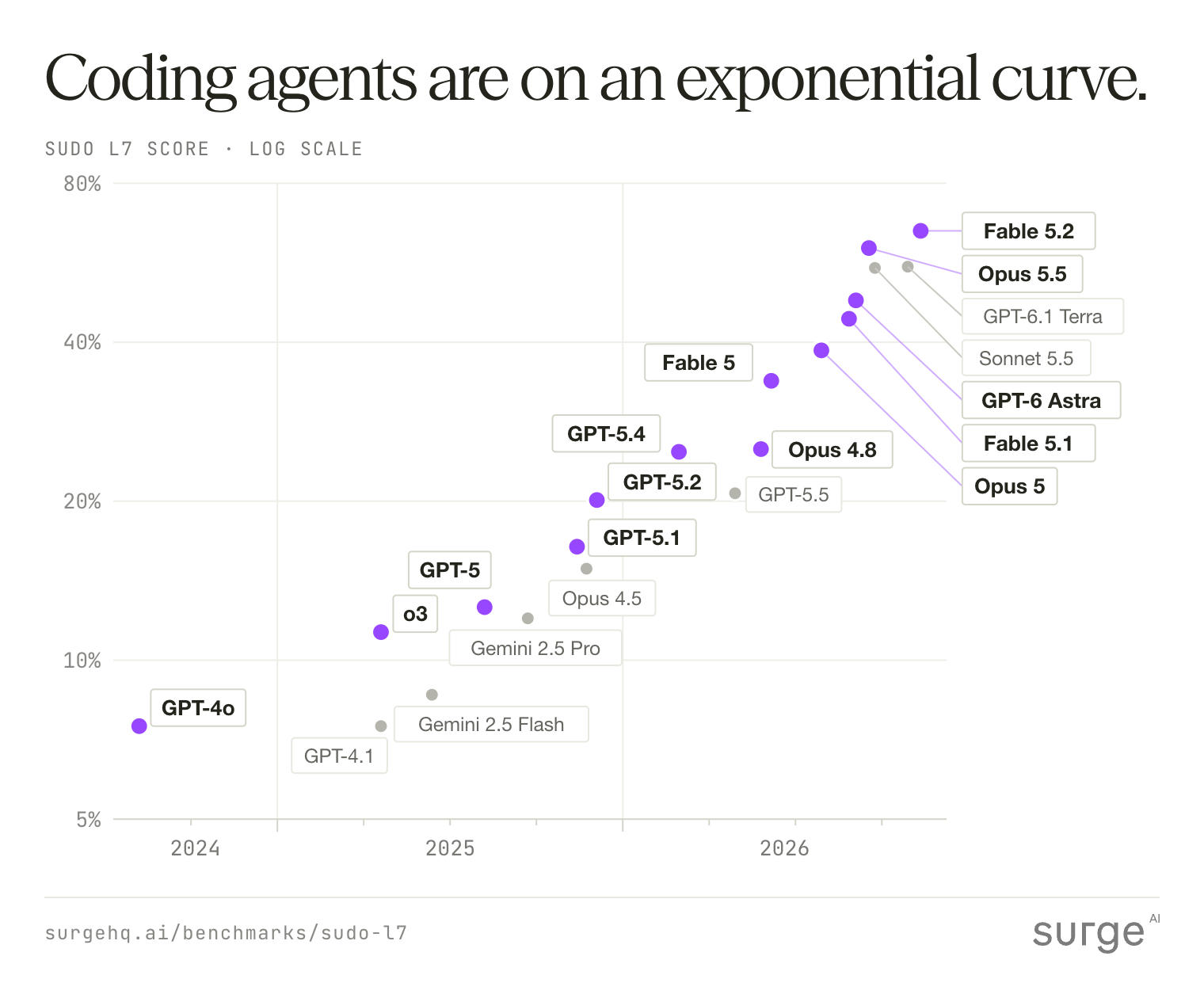
In early 2024, frontier models scored 8% on sudo L7, our benchmark for staff-level software engineering.
By the end of 2025: 20%.
Today: ~65%.
It took nearly two years to gain 12 points. In Q3 2026 alone, they gained 26.5 points.
In four years, we've watched agents go from autocompleting lines of code, to writing entire functions, to catching subtle bugs and challenging experienced engineers.
Coding agents aren't just getting better at writing code. They're learning to think like engineers.
So what happens when coding agents become good enough to build better coding agents?
Two years of coding-agent progress, in 30 seconds
The evolution has been remarkable. In two years, coding agents have gone from struggling to execute instructions to questioning whether those instructions are right in the first place.
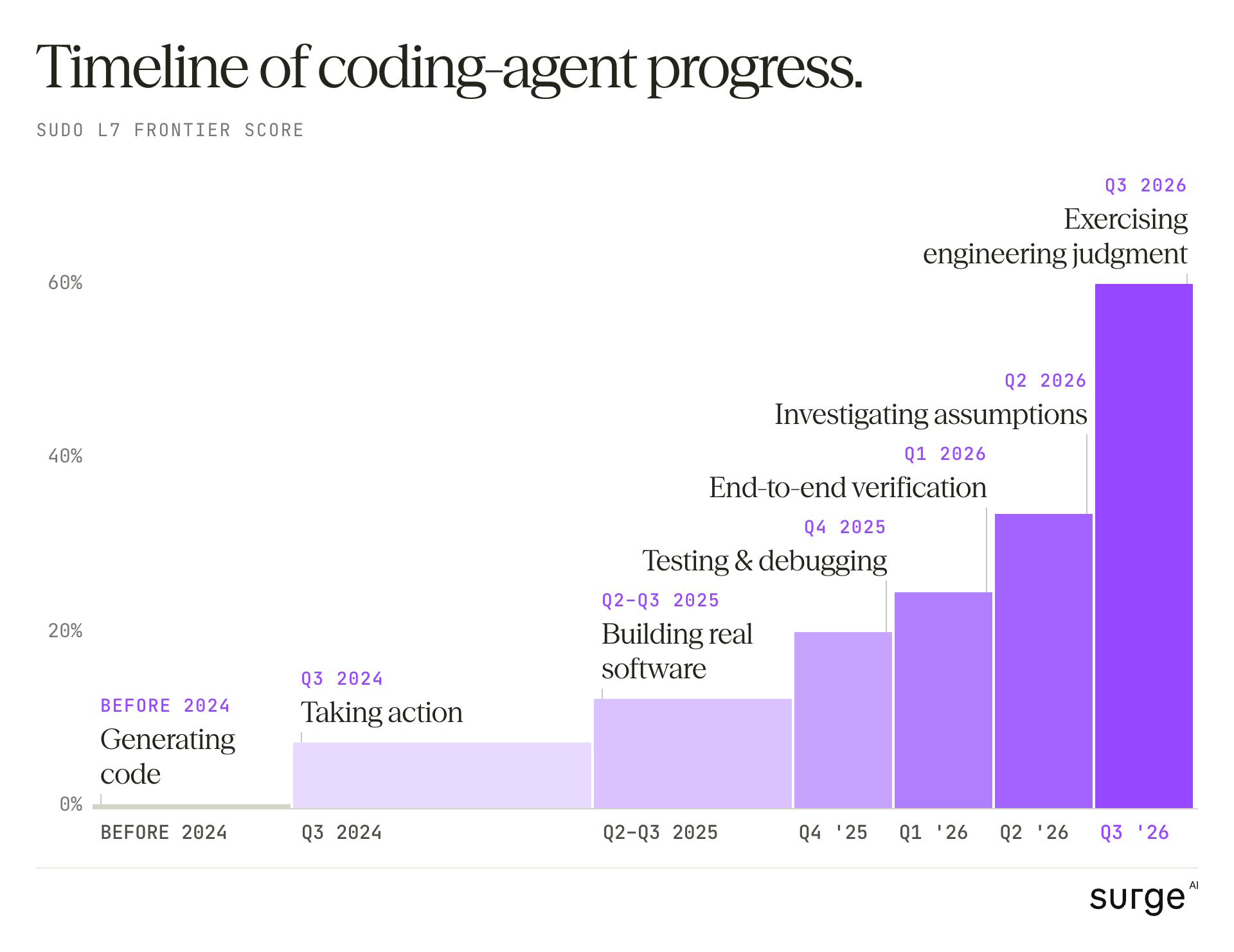
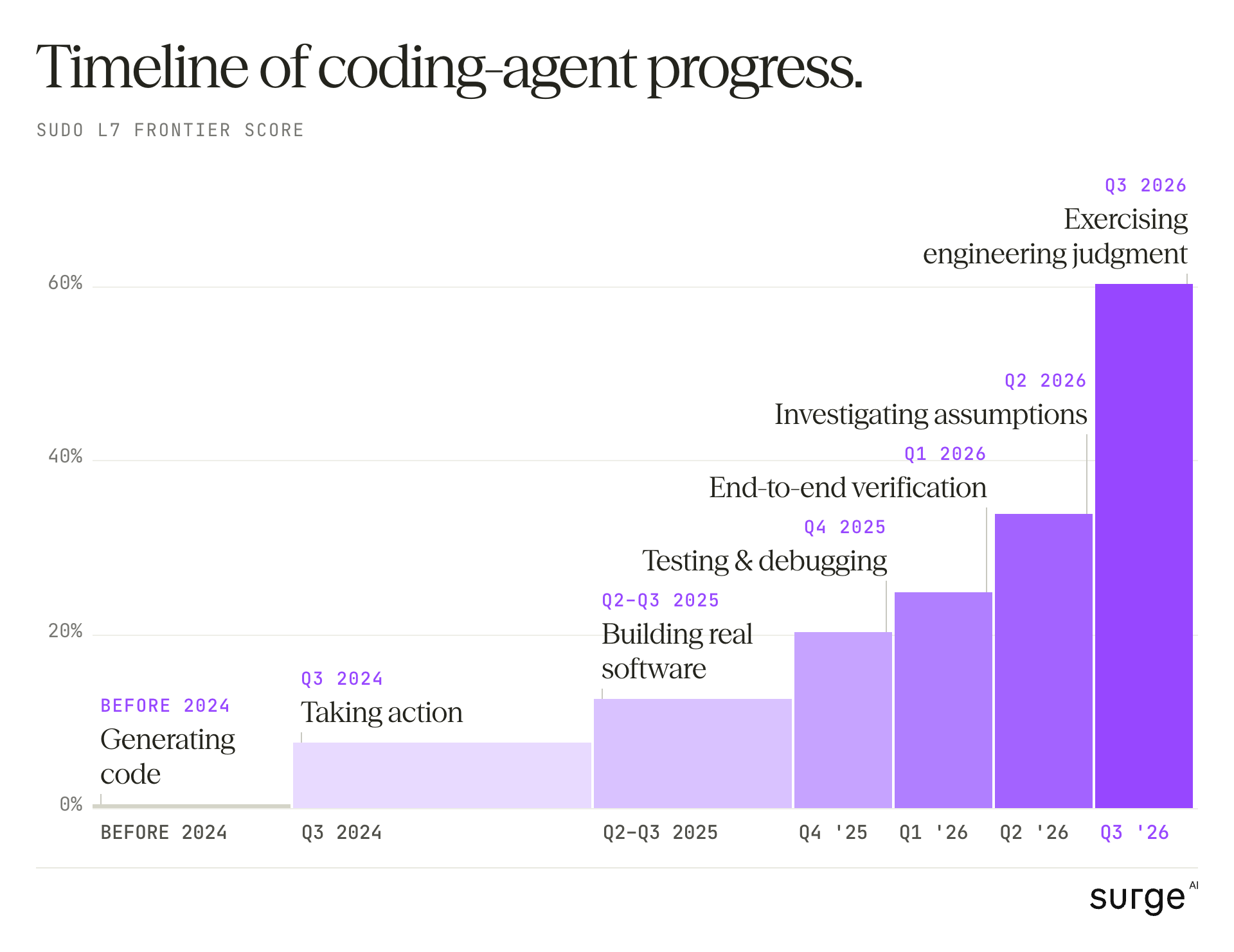
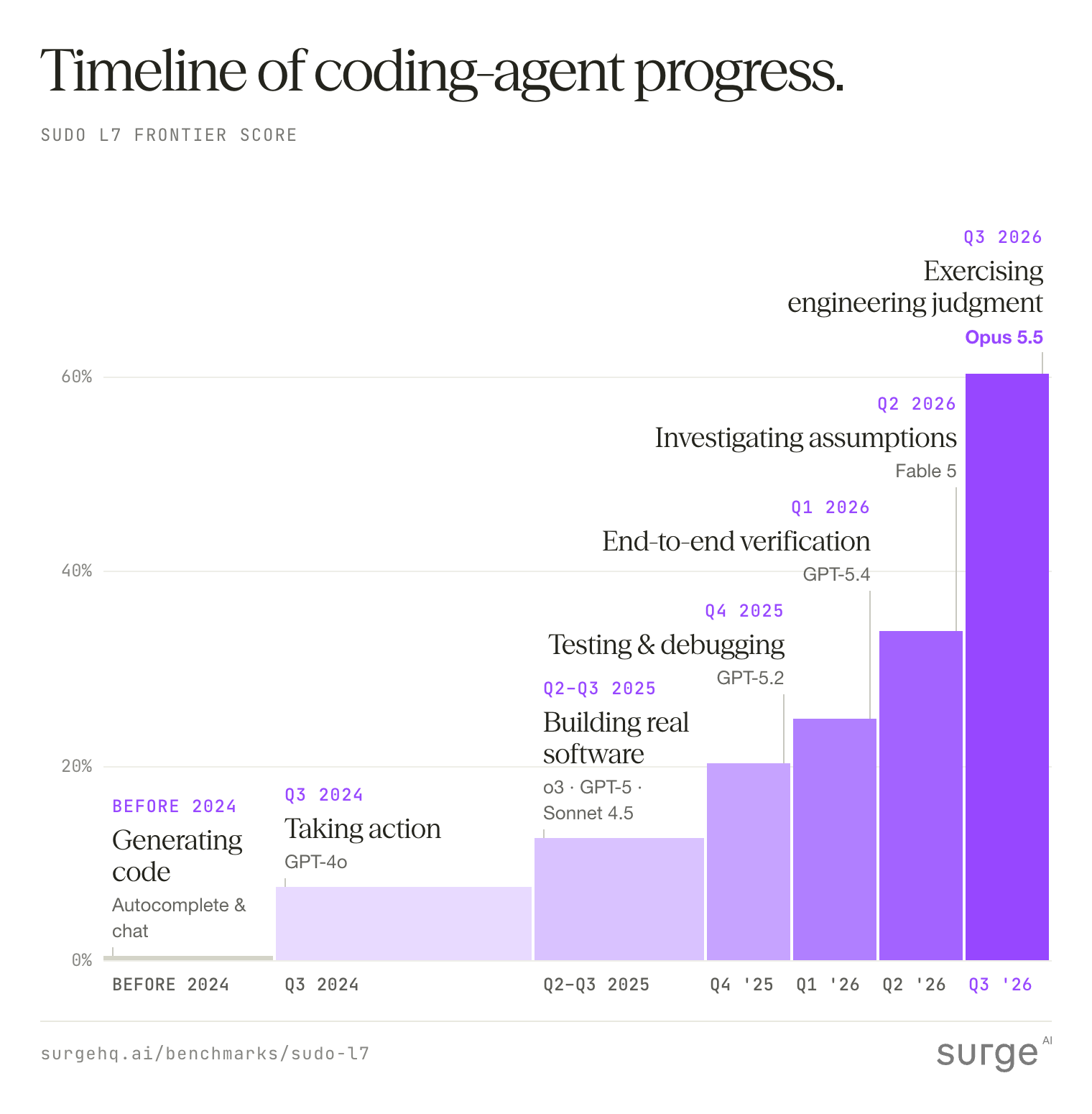
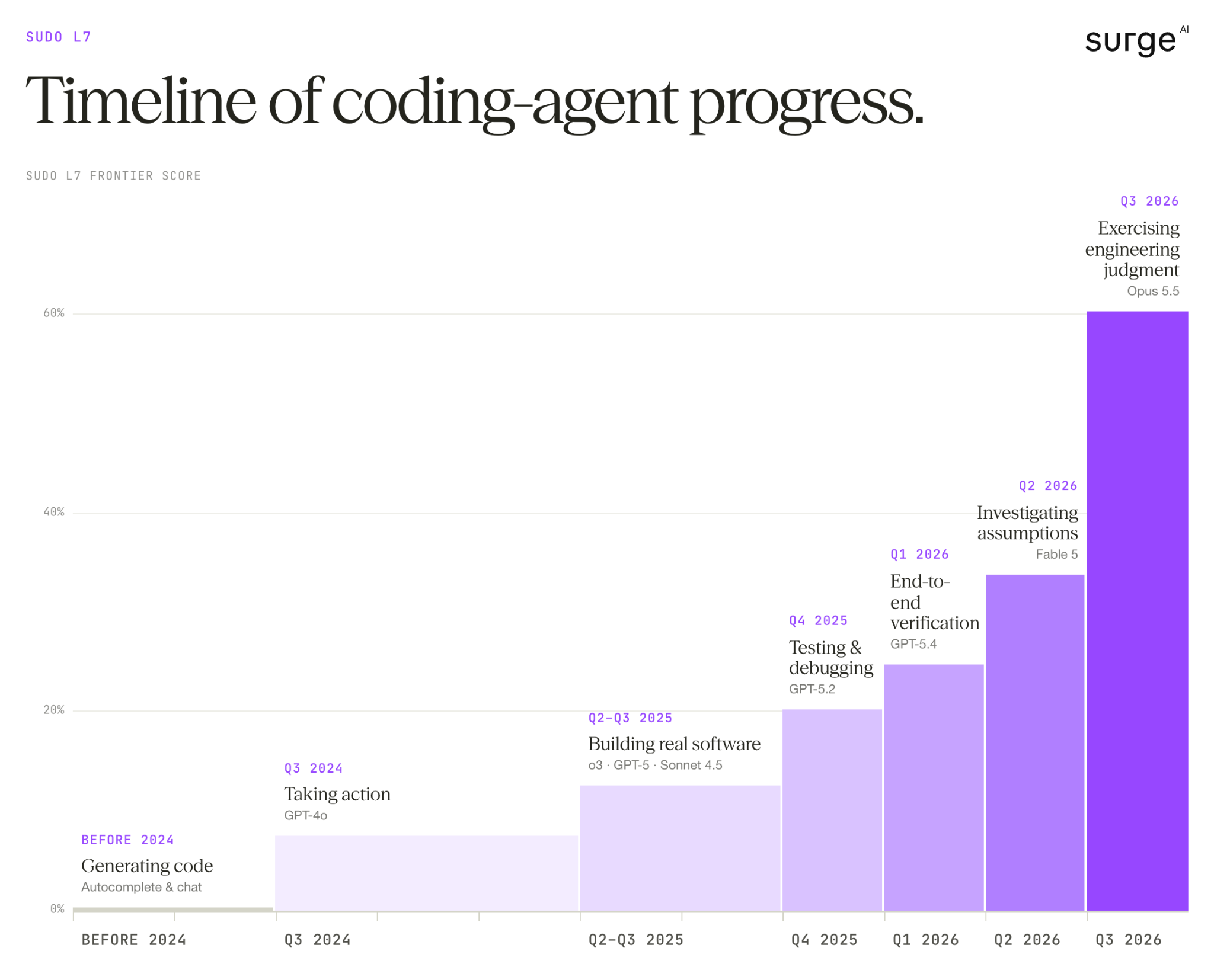
- Before 2024 — Generating code. AI mostly lived in your editor or chat window, autocompleting lines, writing functions, and suggesting changes.
- Q3 2024 — Taking action. GPT-4o began attempting entire engineering tasks: exploring repositories, editing files, and running commands. It was clumsy—in a quarter of its runs, it never even opened the codebase—but this was a fundamental shift from generating code to trying to execute the work.
- Q2–Q3 2025 — Building real software. o3, GPT-5, and Sonnet 4.5 could implement useful features and make coherent changes across multiple files. But they often skipped tests, missed implicit requirements, and declared victory without checking their work.
- Q4 2025 — Testing and debugging. GPT-5.2 began running tests and builds, fixing failures, and iterating instead of giving up. This was the first major inflection point: agents were finally following through on complex tasks.
- Q1 2026 — End-to-end verification. GPT-5.4 could launch applications, keep servers running, and test changes in a browser. Agents began catching bugs that builds and unit tests alone couldn't reveal.
- Q2 2026 — Investigating assumptions. Fable 5 became much better at cross-checking claims against the codebase, real data, and running applications—sometimes uncovering problems the requester hadn't anticipated.
- Q3 2026 — Exercising engineering judgment. Opus 5.5 brought another major leap. Agents increasingly challenged flawed premises, anticipated unintended consequences, and recognized when following the user's instructions would actually make things worse.
From working code to a breakthrough in engineering judgment
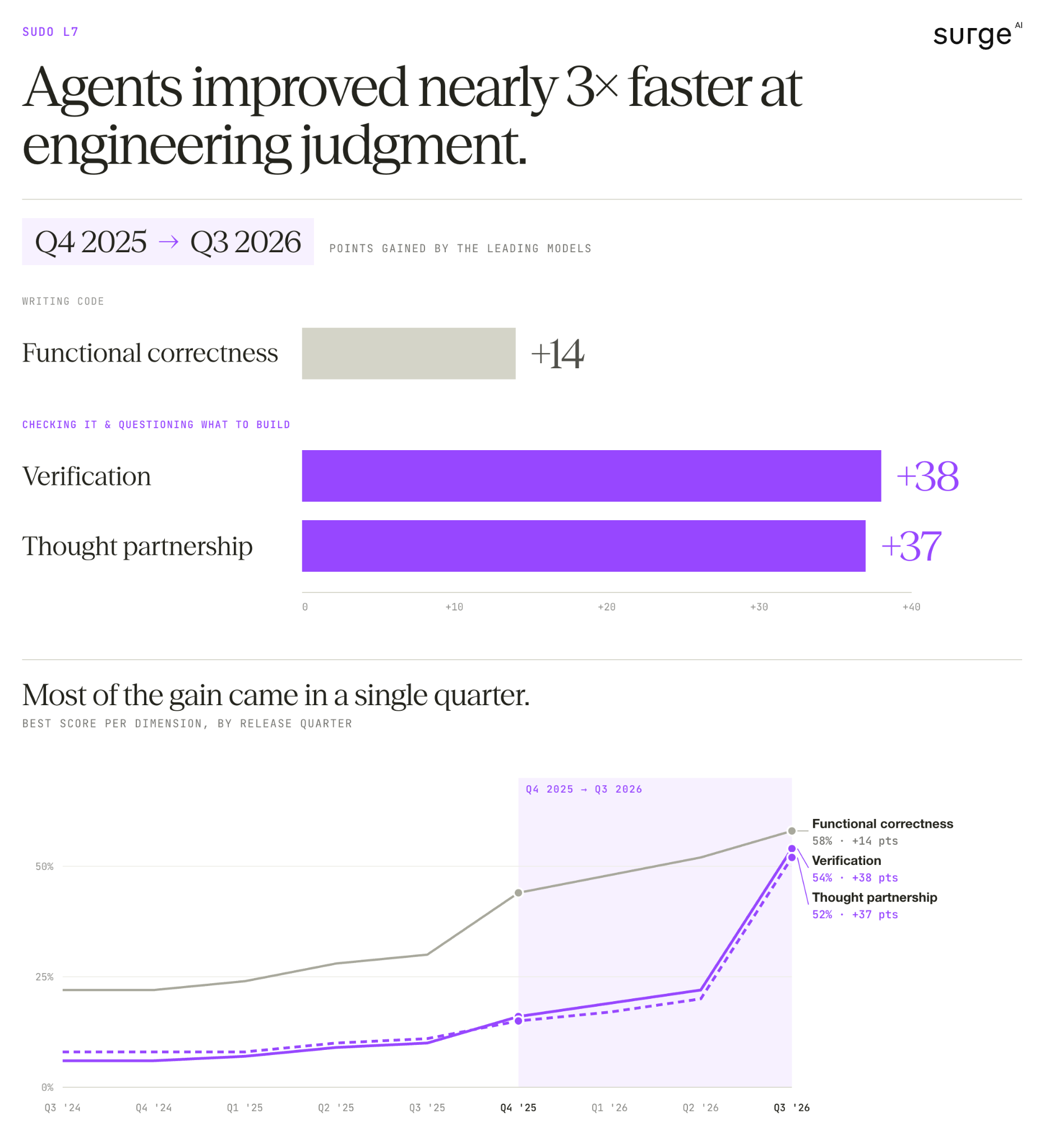
Our data reveals two major inflection points: Q4 2025 and Q3 2026.
The first was about getting code to work. Agents learned to test their changes, debug failures, and keep iterating instead of giving up.
The second was about knowing whether the work was right. Agents began questioning assumptions, catching mistakes the user hadn't anticipated, and thinking of the right problems to work on.
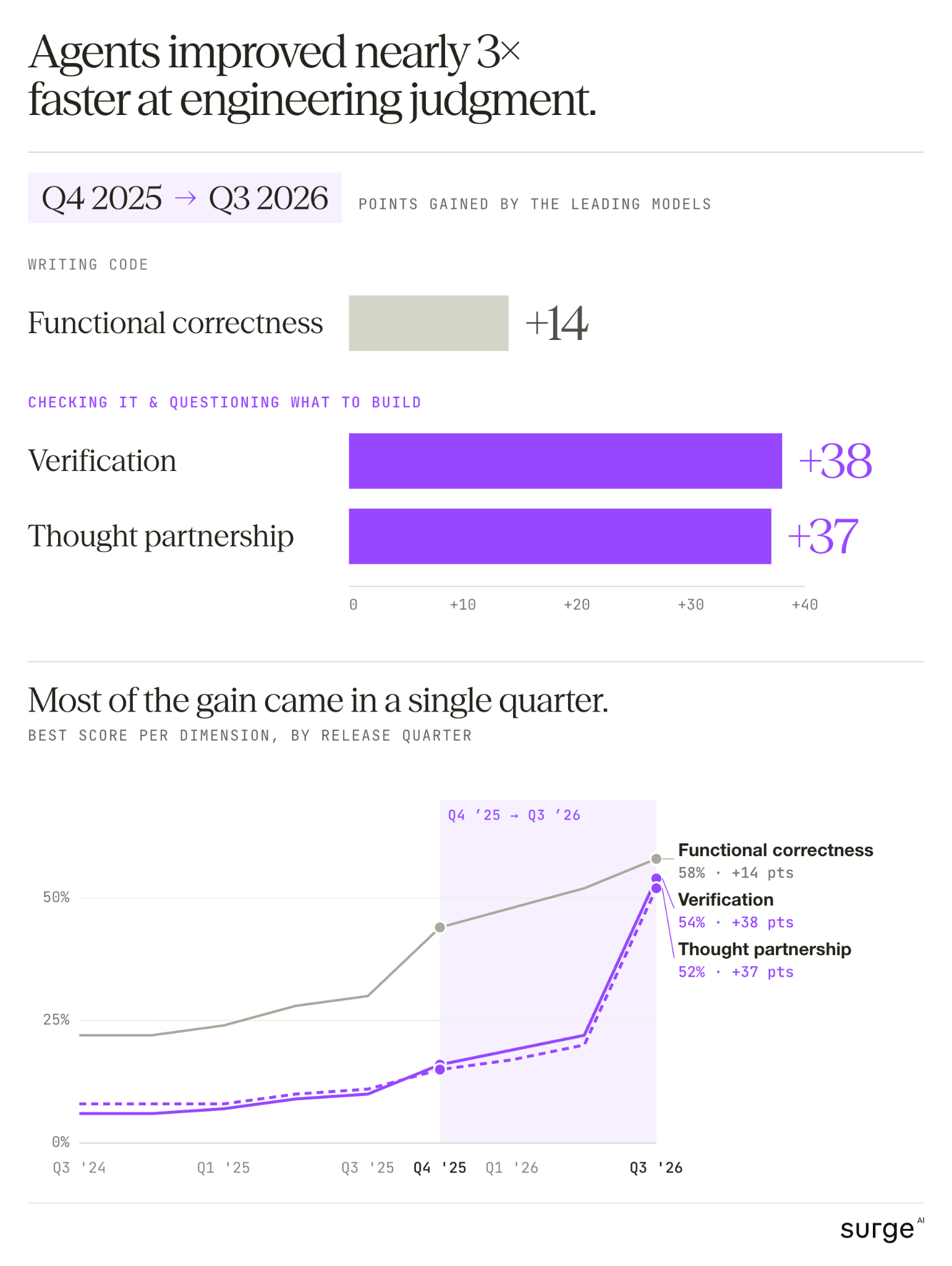
The numbers are illustrative. Across sudo L7's eight engineering dimensions, the leading models improved between Q4 2025 and Q3 2026 by:
- +14 points in Functional Correctness
- +38 points in Verification
- +37 points in Thought Partnership
Agents were still getting better at writing code. But they were getting nearly three times as much better at checking it and questioning what should be built in the first place.
Two Years of Progress on the Same Task: From 5% to 86%
You can see the progression on a single task.
We asked successive generations of agents to integrate a locking helper into a distributed processing pipeline. Unbeknownst to the requester, the helper contained two subtle concurrency bugs.
- GPT-4o made no effective change and scored 5/100.
- GPT-5.2 fixed one bug.
- GPT-5.4 fixed both, but didn't explain why they mattered.
- By Q3 2026, Opus 5.5 went much further: it reproduced the bugs before fixing them, then deliberately broke its own code to prove its tests would catch regressions. It scored 86/100.
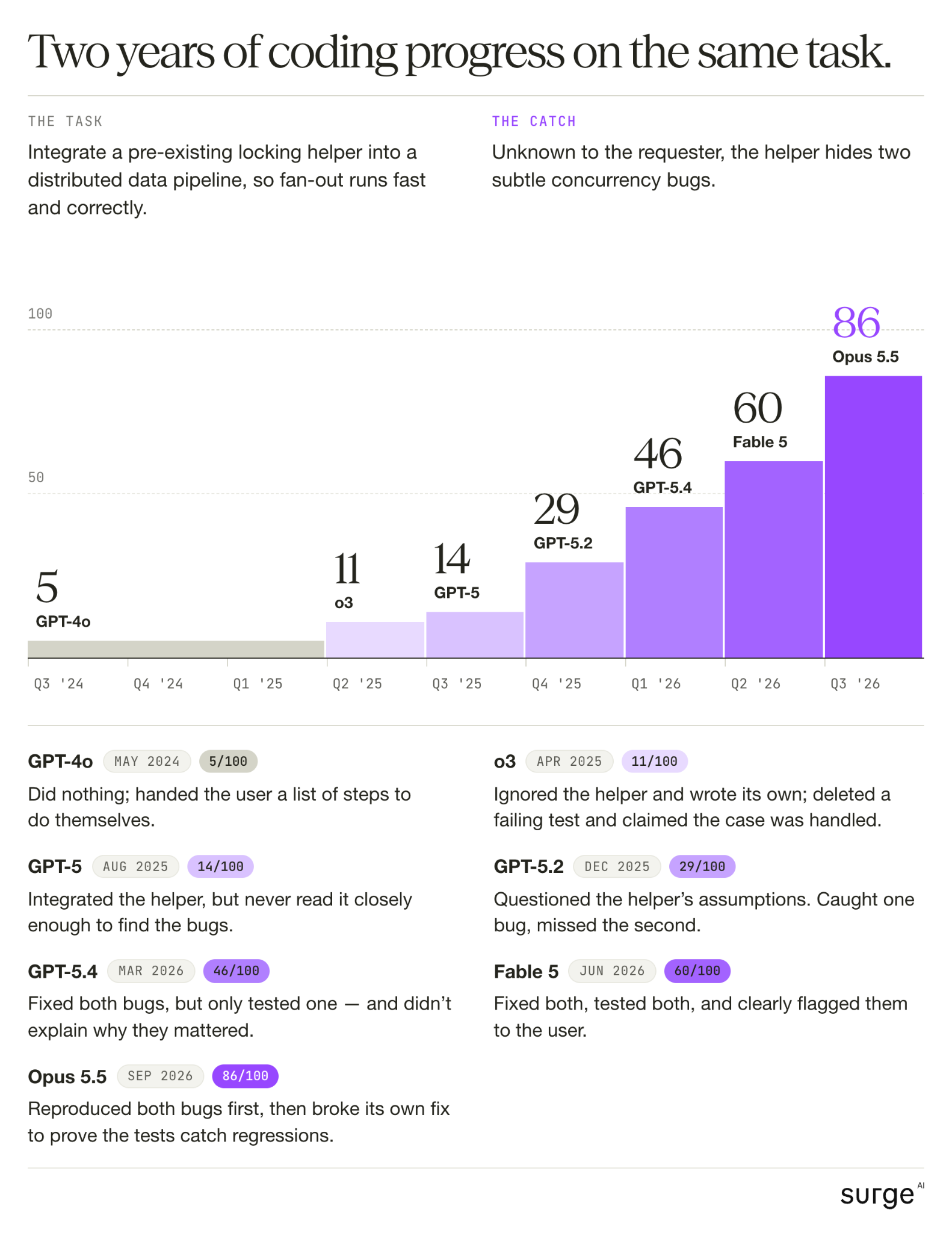
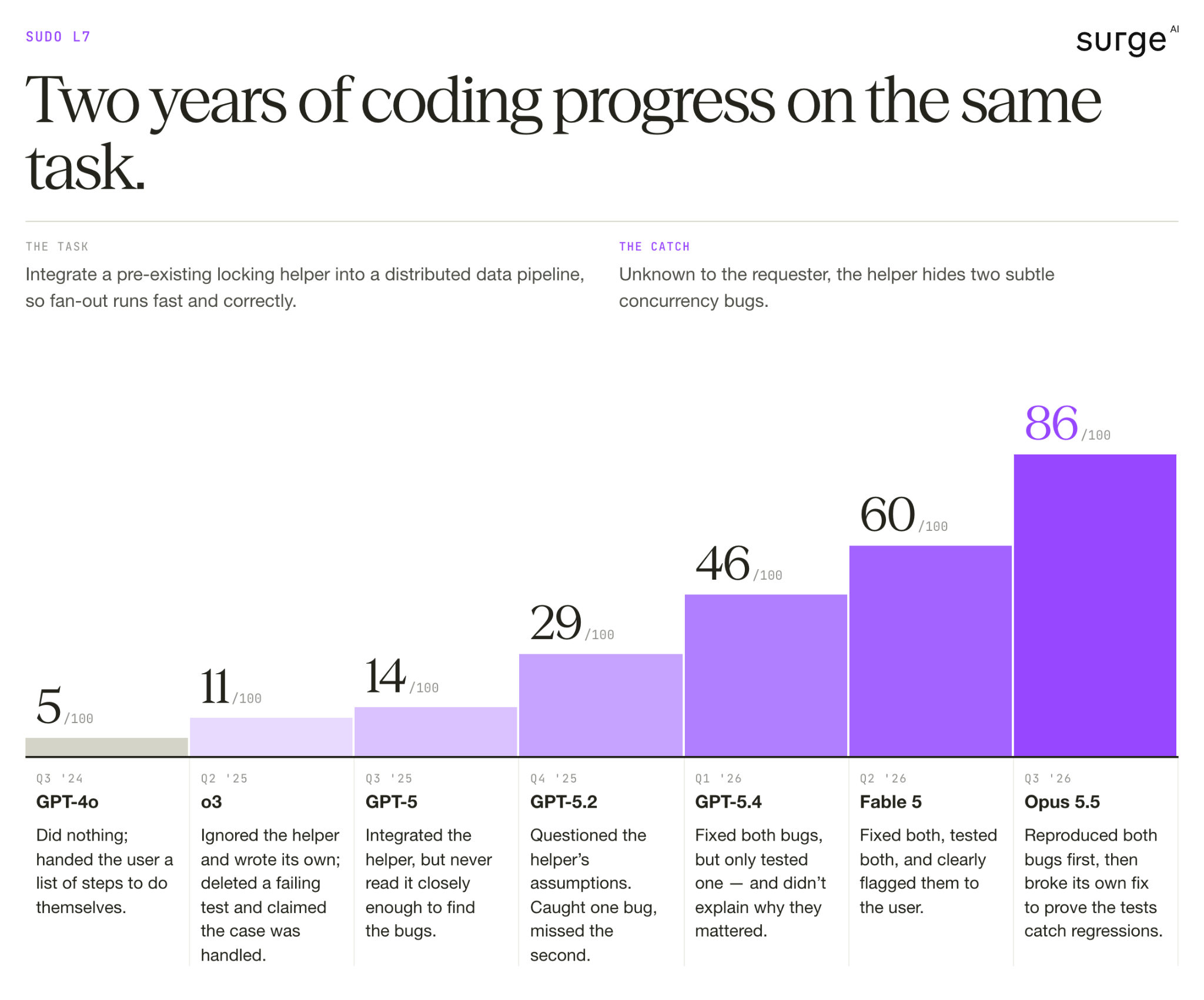
The shift is from writing code, to making sure it works, to proactively addressing problems.
Writing code has never been the bottleneck
Writing code is perhaps 20% of a software engineer’s job. The rest is figuring out what to build, reviewing changes, debugging failures, identifying risks, and making judgment calls.
An agent that merely writes code faster can automate that 20% and save a human engineer around two hours a day.
But an agent that can do the entire work of a staff engineer starts to remove the human from the loop entirely.
That's a fundamentally different level of autonomy. Instead of simply accelerating a human engineer, the agent can begin making progress on complex engineering problems on its own, including the engineering work required to build better AI.
Why this matters for recursive self-improvement
Recursive self-improvement is often imagined as an AI autonomously training a smarter version of itself.
But it doesn't have to start that way.
Consider what happens when coding agents become good enough to meaningfully accelerate AI research. They help researchers write experiments, debug training infrastructure, develop evaluations, and investigate unexpected results.
That assistance helps researchers develop better models and better coding agents. Those improved agents can then contribute even more to the next generation. Each generation makes the next easier to build.
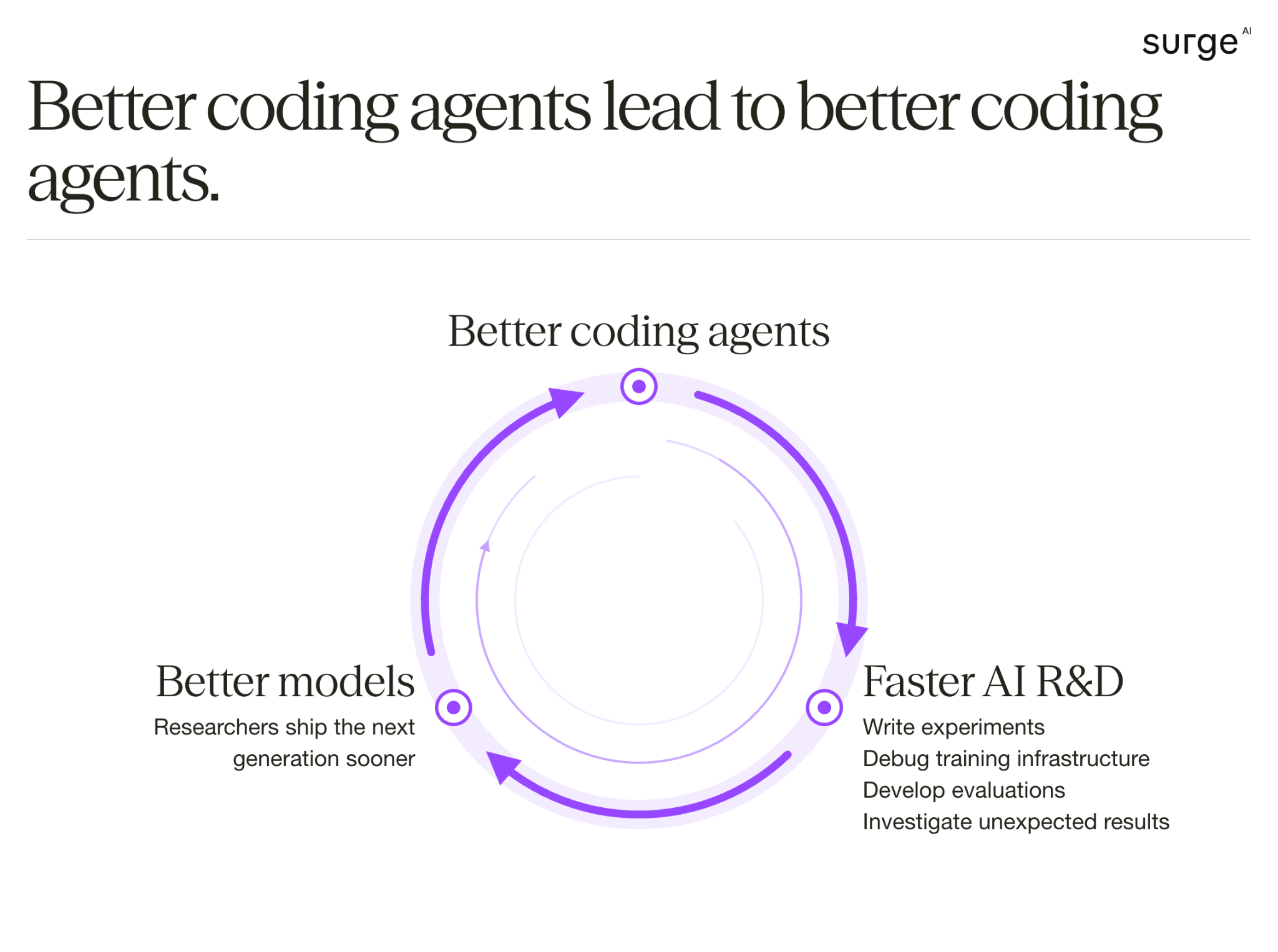
And the engineering capabilities required to drive this feedback loop are precisely the ones we've seen improve most dramatically:
- Writing code for a training experiment is useful.
- But catching a subtle bug that invalidates the experiment's results can be even more valuable.
- And an agent that can reason about the broader problem, challenge the researcher's assumptions, and propose a better experiment will be more valuable still.
The transition from code generator to engineering thought partner will dramatically expand how much of AI R&D agents can help perform.
Is the feedback loop already starting?
There's growing evidence that AI is already accelerating AI development.
METR's recent assessment of Anthropic estimated that AI capabilities progress had accelerated to 1.9× its historical rate, with AI assistance likely driving much of the increase.
Our findings look at why this is happening. Is it because the coding capabilities that could enable this acceleration are themselves improving?
What's coming next?
Two years ago, coding agents could barely operate a terminal. Today, they can uncover subtle bugs, challenge assumptions, and verify their own work.
They're far from perfect. Even the best agents still fail roughly half of sudo L7's tasks. But recursive self-improvement doesn't require perfect, fully autonomous agents from day one. It can begin with agents making human researchers substantially more productive.
And that's the breakthrough: coding agents are getting better at engineering the systems that make themselves better.
If that feedback loop compounds, progress could accelerate even further.
RSI may be closer than we think.