A skill pack promises to make your agent a better code reviewer, PM, or security researcher. Does it really?
We measured, and the answer is: no. Trillion-parameter large language models already know how to do code review. The only thing you're doing is eliciting behavior that already existed – often in a more expensive way.
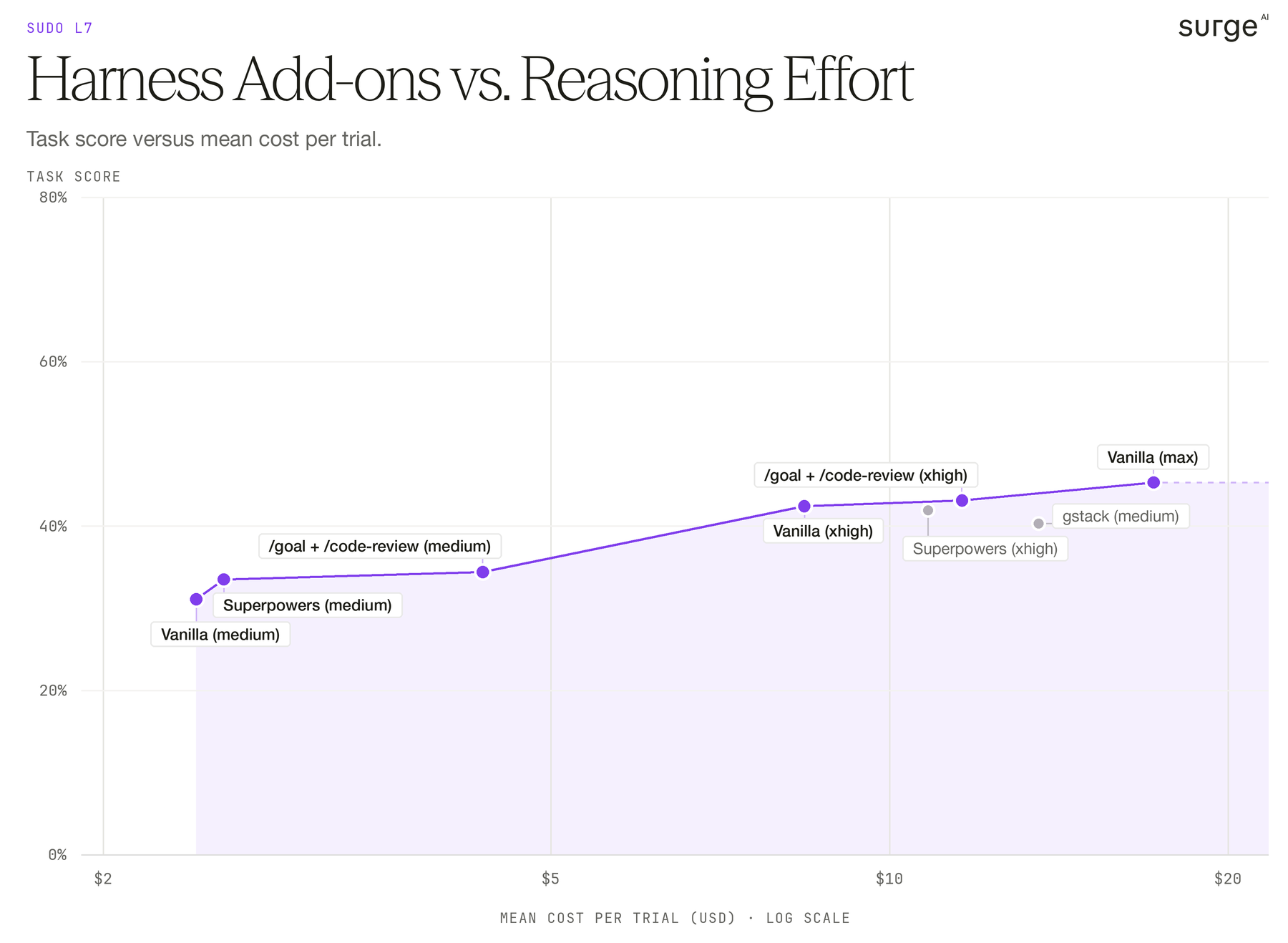
We tested 8 different setups – 5 native and 3 third-party. Only 1 third-party setup was Pareto-optimal.
How we tested
We built sudo L7 to evaluate coding agents on the broader judgment expected of staff engineers. Tasks take place in real codebases, many licensed from operating companies. Human-authored rubrics evaluate task-specific performance on 8 dimensions, including Functional Correctness, Verification, Persistence, and Thought Partnership.
Elicitation increases with reasoning effort
We see that Claude consistently follows more best practices at higher effort levels.
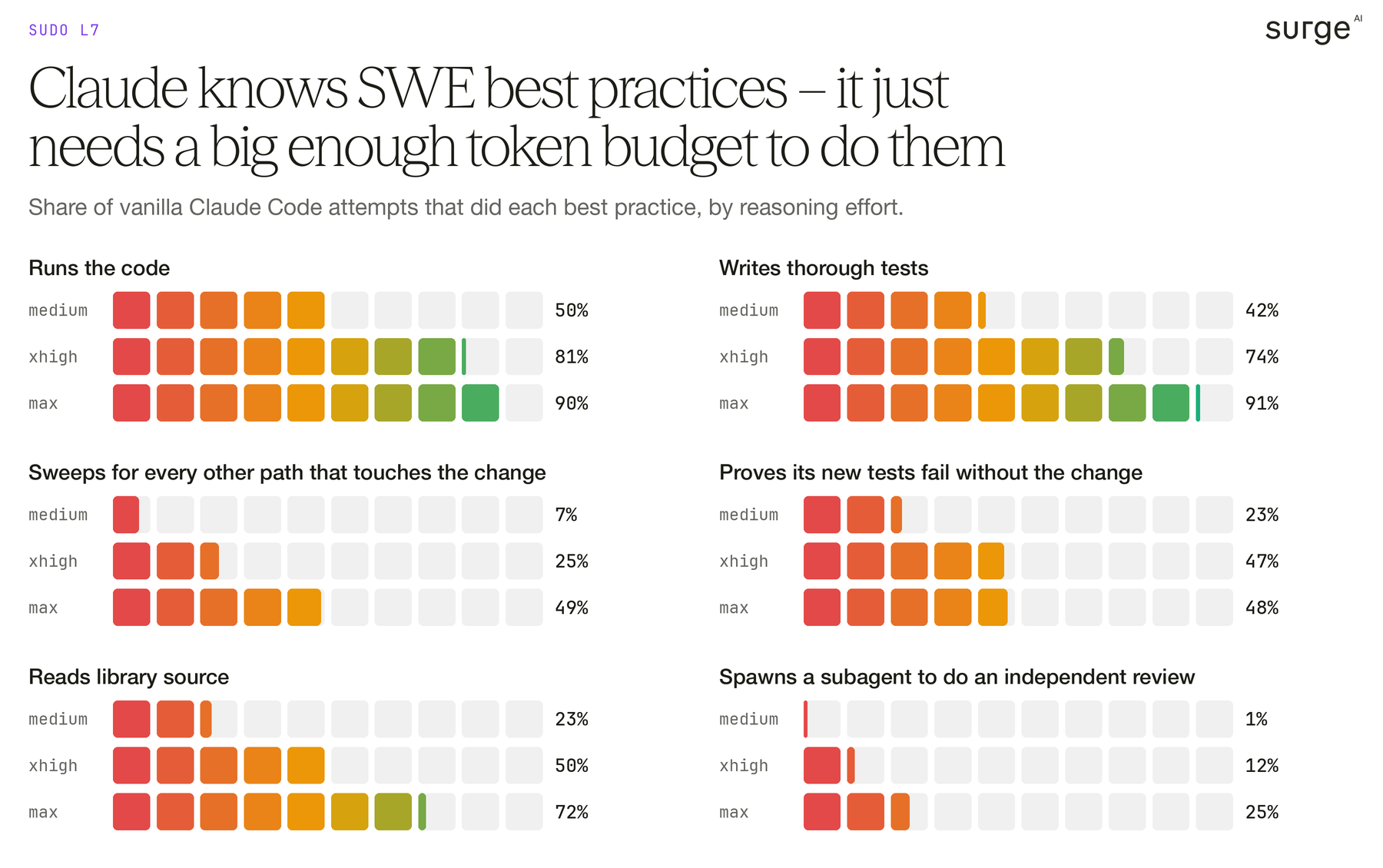
Claude knows that it's a good idea to run the code before declaring that it works. It doesn't need a fancy skill pack to tell it that. It does so when it has the token budget.
Skill packs do the same thing as reasoning effort, but less efficiently
We see a strong correlation between tokens spent and task quality. We didn't find evidence that the skill packs we tested made those tokens smarter – in fact, they were often purchasing the same outcomes at worse prices.
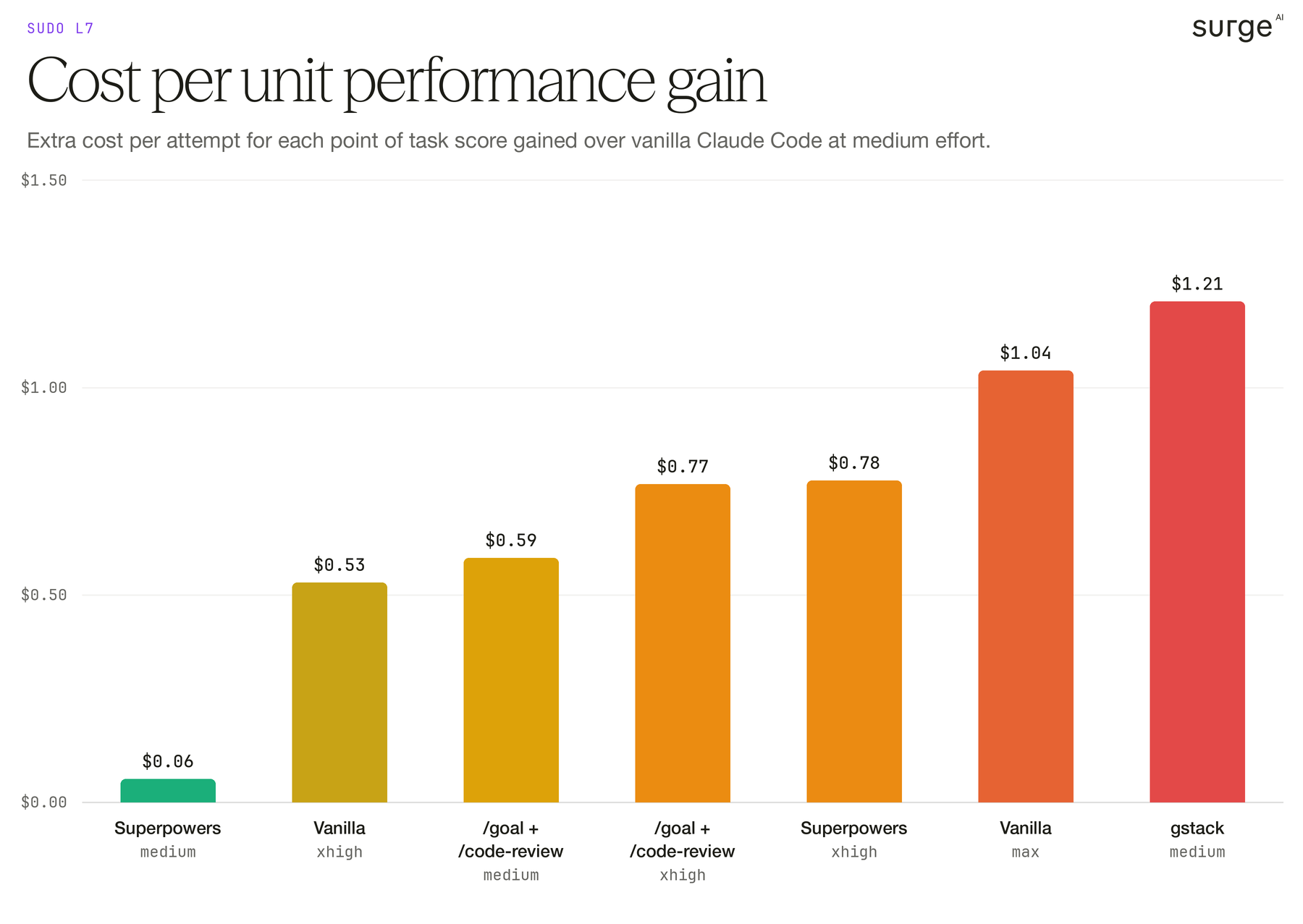
There are a few factors driving this.
Skill packs are often redundant with either the model's intrinsic knowledge or guidance included by the agent author in the system prompt. So they don't actually add that much value.
But they do add cost! When invoked, these skills are attached to every LLM request, meaning you hit compaction sooner and pay higher costs – particularly if you're running a long-lived agentic workflow where your token cache keeps expiring.
And third-party skill packs are at a big disadvantage to first-party ones. Frontier labs have enormous budgets for human evals that measure their coding agents as a full-stack product: model, tools, skills, and more. They also have a variety of production data signals.
A skill pack floating around Twitter has none of that. So the prior should be that, unless the skill pack has its own human evals, it's a wash at best and harmful at worst.
Let agents cook
Given enough time to work, agents are very strong software engineers. This includes applying their own judgment about when to get an external review or when to test a change at multiple layers of the stack.
When we add a skill pack that mandates certain approaches, we're essentially micromanaging the model with bureaucratic rules. The reason that big institutions do this is the same reason we did it to older models: a lack of trust.
But agents have improved rapidly, and micromanaging is now net harmful.
You can just ask for things!