Blog
Leaderboards
Workforce
Products
Research
Careers
Contact
Login
All Leaderboards
Close
Thank you! Your submission has been received!
Oops! Something went wrong while submitting the form.
Receive updates
mathematics at the frontier

Riemann-bench

Beyond simple arithmetic and symbolic manipulation. We evaluate AI models on advanced mathematical problems requiring deep reasoning, topological insight, and rigorous proof construction. Our benchmark features problems from cutting-edge mathematics—sourced from leading mathematicians—to measure true mathematical understanding, not just pattern matching.

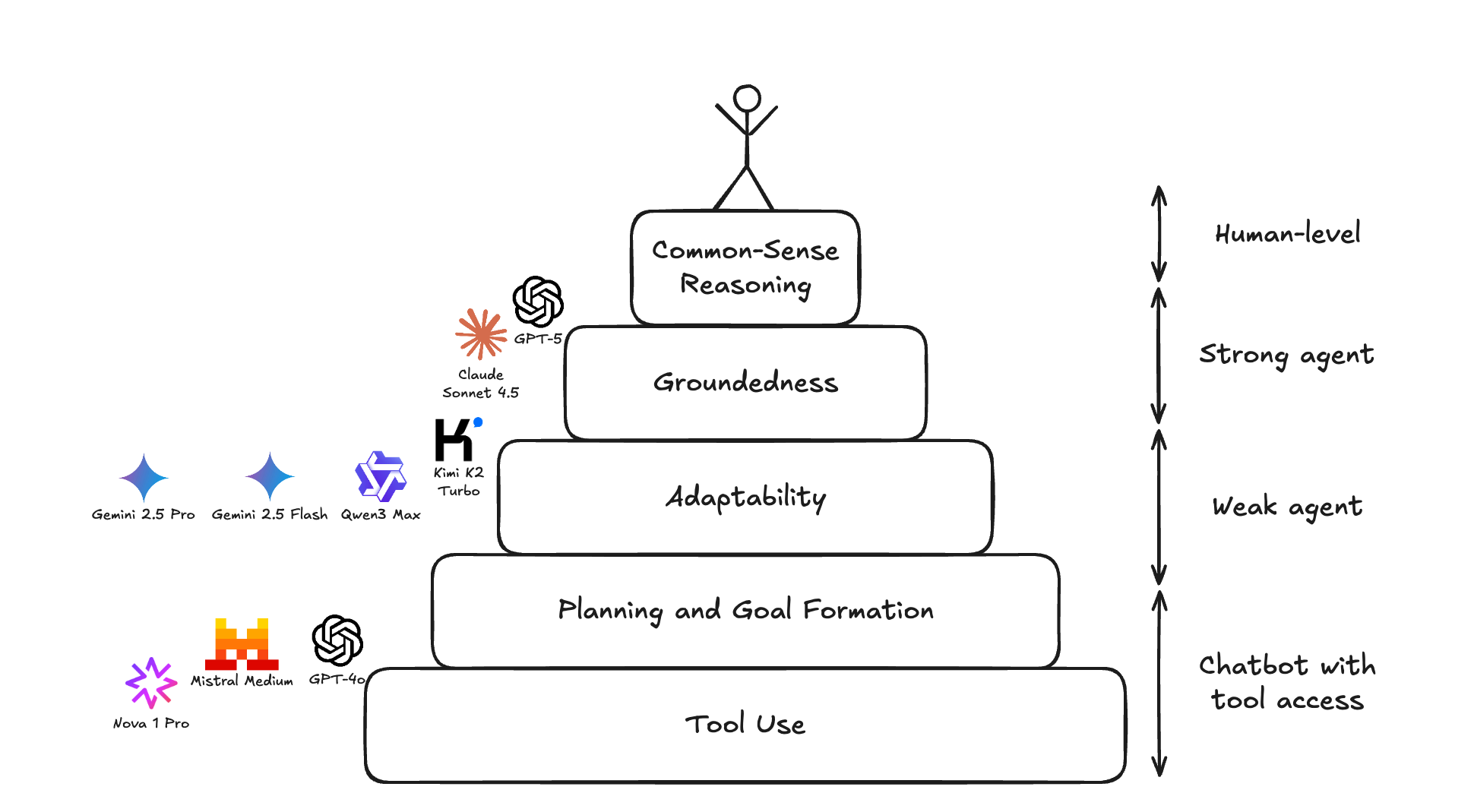
RL Environments and the Hierarchy of Agentic Capabilities
Our RL environment run on 9 models revealed the core capabilities all agents need to master: tool use, planning, adaptability, groundedness, and common sense.
Model Rankings
Last updated 03/24/2026
1
Claude Opus 4.6
6
%
1
Gemini 3.1 Pro
6
%
1
Kimi K2.5
4
%
1
Gemini 3 Pro
4
%
1
DeepSeek v3.2
3
%
1
GPT-5.2
2
%
1
Claude Opus 4.5
2
%

Extreme Difficulty, Rigorous Verification

Robust Maximal Independent Sets
Problem

A robust maximal independent set in a graph $G$ is a maximal independent set that remains maximal in all connected spanning subgraphs of $G$. How many connected graphs on $12$ vertices have the property that every maximal independent set is a robust maximal independent set, up to isomorphism?

Correct Answer
Explanation
Hahn Series and Multibasic Modules
Problem

Notation and definitions for background context:

Let $F$ be the field of order 2. Let $K$ be the field of Hahn series in indeterminate $t$ with value group $\mathbb{R}$ and residue field $F$. Let $A$ be the subring of $K$ consisting of those $a \in K$ with non-negative valuation. Consider $K$ as an $A$-module. For $q \in \mathbb{R}$, let $I_q = t^q A$ and $I_{>q} = \bigcup_{r>q} I_r$. Write $A/I_{>0}$ as $F$, since they are identical both as $A$-modules and as fields. Let $\Theta = K/I_{>0}$ and $\Phi = K/A$. We say that an $A$-module $M$ is 'basic' if it is isomorphic to $L/N$ for some $N < L \le K$, and that it is 'multibasic' if it is a direct sum of a (possibly empty) finite list of basic modules. For $A$-submodules $U, V$ of $K$, let $U + V = \{a + b : a \in U, b \in V\}$, $UV = \{ab : a \in U, b \in V\}$, and $c(V) = \{a \in K : aV \le I_{>0}\}$.

You may assume the following facts:

Fact 1: The decomposition of a multibasic $A$-module into basic submodules is unique up to the order of the summands.

Fact 2: If $M_i = L_i / N_i$ and $N_i < L_i \le K$ for $i = 0, 1$, then $M_0 \otimes M_1 = \frac{L_0 L_1}{L_0 N_1 + N_0 L_1}$ and $D(M_0) = c(N_0) / c(L_0)$.

Find the number of distinct isomorphism classes of multibasic $A$-modules $M$ satisfying the following conditions:

(i) $K \otimes \text{End}(M) = K$.

(ii) $F \otimes \text{End}(M) = F$.

(iii) Let $e_r = \dim_F(F \otimes I_r \text{Hom}(I_{>0}, M))$ for all real $r \ge 0$. Then $\lim_{p \to q^-} e_p = e_q$ for all real $q > 0$ except for integers $q$ with $29 \le q \le 328$.

If your answer is infinite, write -1.

Correct Answer
Explanation
Eynard-Orantin Topological Recursion
Problem

Consider the Eynard Orantin Topological Recursion Formalism for the spectral curve $(\mathbb{C}\mathbb{P}^1, x, y, \omega_{0,2}(x, y))$, where $x = t + 1/t$ and $y = t^3 / 3$, and the fundamental bidifferential is given by $\omega_{0,2}(x_1, x_2) = \frac{dz_1 dz_2}{(z_1 - z_2)^2}$, with $z_1, z_2 \in \mathbb{C}\mathbb{P}^1$. Note that $x$ has two simple ramification points at $\pm 1$ of order $2$ with deck transformation $\theta(t) = 1/t$.

Please calculate the Free energies $F_2$ and return it as a rational fraction in the format $a/b$ for $a$ and $b$ coprime. Recall that the free energies $F_g$ can be computed as the following integral $F_g = \frac{1}{2g-2} \sum_{a \in \Delta} \text{Res}_{q=a} \Phi(q)\omega_{g,1}(q)$, where $\Phi(q) = \int_{o}^{q} y(t)dx(t)$, for an arbitrary base point $o$.

Correct Answer
Explanation

Find out about
leaderboard updates

Blog
Leaderboards
Workforce
Products
Research
Careers
Contact
Login